
Get Found First: 10 Steps to Rank Higher for Local & “near me” Searches
A practical, no-jargon guide to winning the customers searching for a business like yours right now. Updated for 2026 - including Google, Maps, voice, and the new wave of AI search.
A practical, no-jargon guide to winning the customers searching for a business like yours right now. Updated for 2026 — including Google, Maps, voice, and the new wave of AI search.
"Near me" is where customers decide
Think about the last time you needed something fast — a coffee, a locksmith, an urgent dentist appointment. You probably reached for your phone and searched for it "near me." That single habit now drives a huge share of how people discover and choose local businesses, and it has only accelerated.
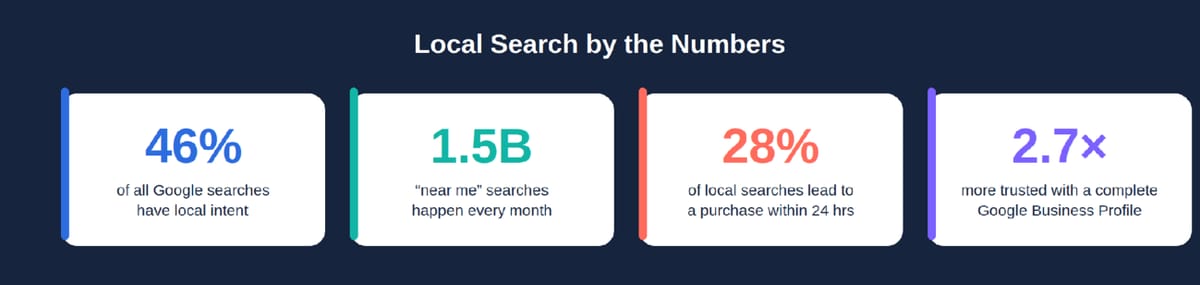
Roughly 46% of all Google searches have local intent, and there are about 1.5 billion "near me" searches every month — around 50 million every single day. These aren't idle browsers: 28% of local searches end in a purchase within 24 hours, and the large majority of people who search locally on a phone visit or call a business within a day.
It adds up to a simple truth: about 80% of consumers look up local businesses online every week, and 99% have used the internet to research one before visiting. If your business isn't showing up — and showing up well — you're effectively invisible at the exact moment someone is ready to buy. The good news? Local visibility is something you can earn, step by step.
How Google decides who ranks locally
Google weighs three core factors when it builds local results and the map pack. Understanding them tells you exactly where to focus your effort.
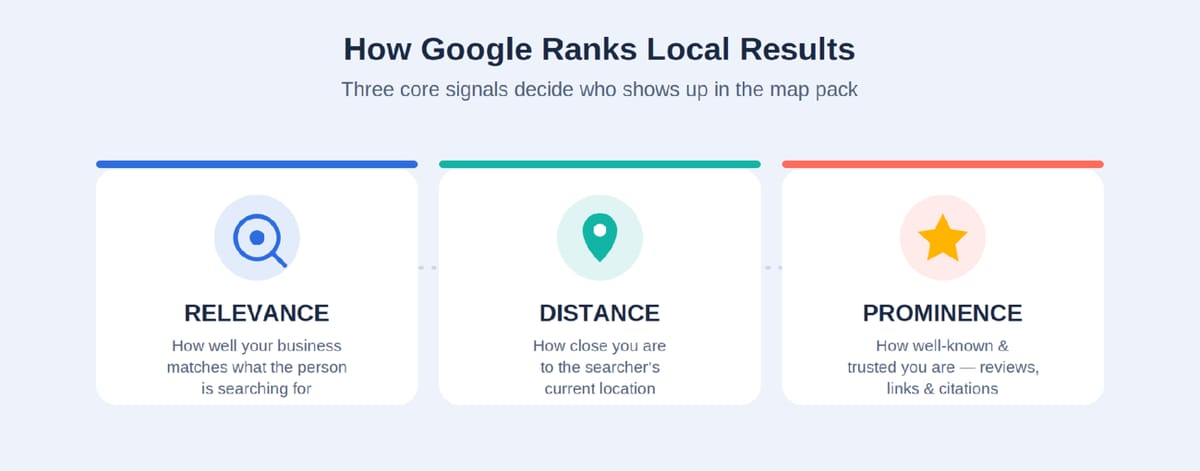
Relevance — how well your business profile and website match what the person typed. Complete, detailed, accurate information helps Google understand you and match you to more searches.
Distance — how close you are to the searcher. If someone doesn't specify a location, Google estimates it. You can't move your building, but you can make your location signals crystal-clear.
Prominence — how well-known and trusted you are. This is driven by reviews, links, citations, and overall online presence — and it's the factor you have the most power to grow.
Local search is more sophisticated than most people realize — industry analysts estimate Google uses well over a hundred signals for local results. Yet many businesses leave easy wins on the table: by some estimates only about a third of small businesses have even claimed their Google Business Profile.
6 mistakes that quietly bury your rankings
Before adding anything new, make sure you're not undermining yourself with one of these common issues:
- Too few reviews — or ignoring the ones you have. Reviews are a trust signal for customers and a ranking signal for Google. Responding to every review (good or bad) is one of the simplest ways to lift local visibility.
- Inconsistent NAP details. Your Name, Address, Phone, and Website must match everywhere they appear. Around 73% of consumers say they won't trust a business whose listing information is incorrect, and many abandon a search entirely over a wrong address.
- An unverified or unclaimed profile. Google places more trust in verified businesses. Claiming your profile also lets you control your branding, photos, hours, and information.
- Duplicate listings. Multiple listings for the same business confuse Google and split your signals. Find and merge or remove duplicates.
- Keyword stuffing. Cramming the same phrase into your content reads badly and can trigger penalties. Write naturally for people first.
- Broken links and a neglected website. Dead links (404s) hurt both user experience and the link signals Google relies on. They're an easy, high-value fix — more on this at the end.
The Local Pack: what you're competing for
Those top three businesses with the map at the top of a local search are the Local Pack — and they capture the lion's share of clicks and calls. Earning one of these spots is the single highest-impact outcome of local SEO.
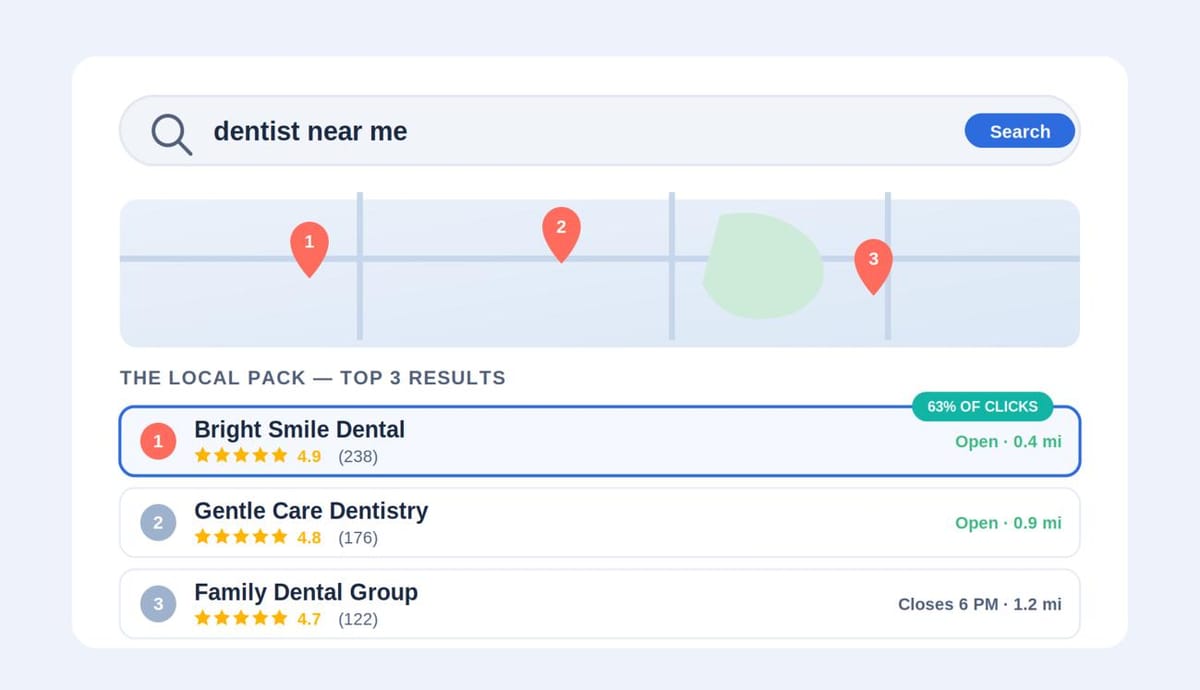
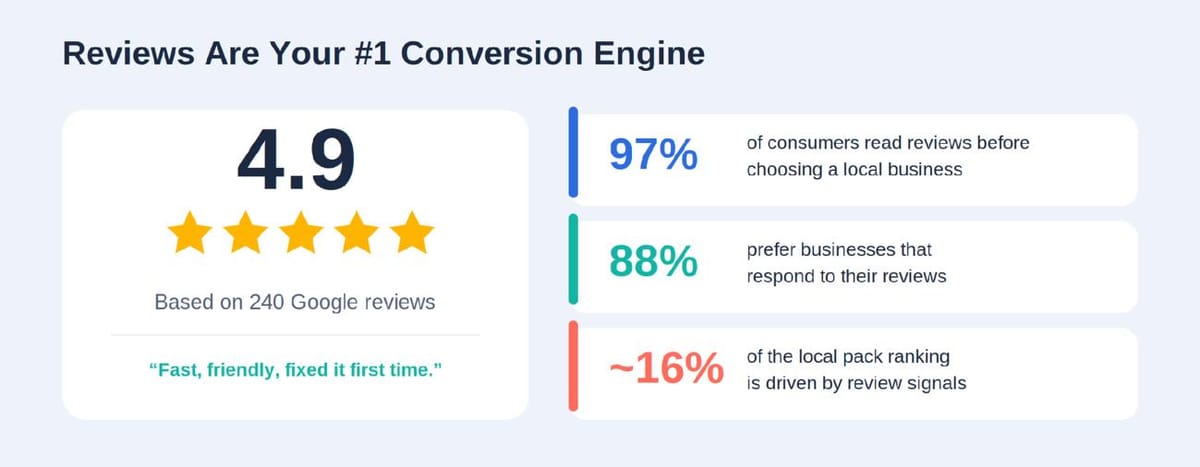
Reviews play an outsized role here. Industry analyses estimate that review signals account for roughly 16-20% of how the local pack is ranked, and businesses ranking in the top three tend to have noticeably more reviews than those further down. Get the fundamentals right and a top-three position is well within reach.
10 steps to start using today
Work through these in order. The first few deliver the fastest gains; the later ones compound over time and future-proof your visibility.
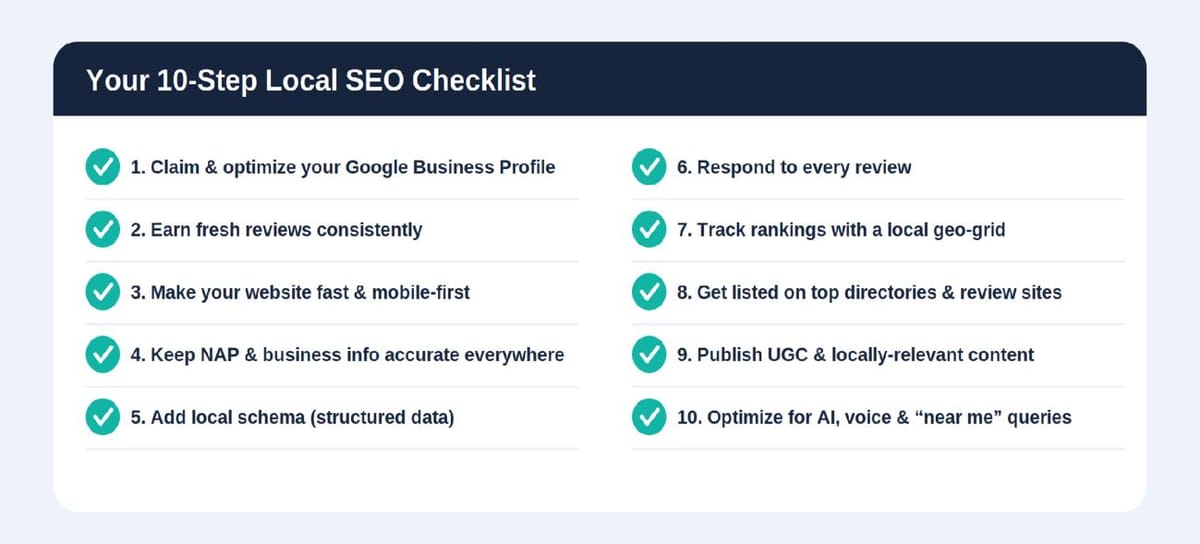
1. Claim and fully optimize your Google Business Profile
Your Google Business Profile (formerly Google My Business) is a free listing and the centerpiece of local search. Fill out every section: categories, services, hours, photos, attributes, and a keyword-rich description. The payoff is real — businesses with a complete profile are 2.7x more likely to be trusted by customers and significantly more likely to earn clicks, calls, and visits. A profile isn't set and forget; keep it fresh with posts, new photos, and updated hours.
2. Earn fresh reviews — consistently
Asking happy customers for reviews is one of the highest-ROI things you can do. But recency matters as much as volume: many consumers only fully trust reviews written in the last month, so a steady weekly trickle beats a one-time burst. Make asking part of your routine — a quick text or email after each job works wonders. Aim for a believable 4.7-4.9 average; a flawless wall of 5.0s can actually read as less authentic.
3. Make your website fast and mobile-first
The majority of local searches happen on phones, and if your site isn't mobile-friendly, visitors are far more likely to bounce straight to a competitor. Prioritize quick load times, easy tap targets, clear contact buttons, and clean navigation. Google's Core Web Vitals (loading, interactivity, and visual stability) are part of how it judges your pages — a fast, smooth site helps both rankings and conversions.
4. Keep your business information accurate everywhere
Consistency builds trust with both customers and Google. Make sure your hours, address, phone number, and service areas are identical across your website, Google profile, and every directory. Update promptly for holidays and changes — nothing erodes trust faster than a customer arriving at a closed door.
5. Add local schema (structured data)
Schema markup is code that helps search engines understand your content — your address, hours, services, and reviews. Adding LocalBusiness schema that matches your site and Google profile makes you eligible for richer results and helps Google (and AI engines) surface quick, accurate answers about your business. It's technical but high-leverage; Google's Structured Data Markup Helper is a friendly starting point.
6. Respond to every review
Don't just collect reviews — reply to them. Around 88% of consumers prefer businesses that respond to reviews, and the vast majority read the owner's responses, not just the review itself. A gracious reply to a critical review often impresses future customers more than a perfect record would. Responses also signal to Google that your business is active and engaged.
7. Track your visibility with a local geo-grid
Your ranking can vary block by block. A local rank-tracking geo-grid shows how you appear across a map of your service area — hot where you're strong, cool where you're weak. It turns guesswork into a clear picture of where to focus next, and makes your progress easy to see over time.
8. Get listed on the top directories and review sites
Google is the start, not the finish. Claim and align your listings on Yelp, Apple Maps, Bing Places, Facebook, and the directories that matter in your industry. Google reads these citations when assessing your business, and consistent details across all of them reinforce your prominence and reach customers who search beyond Google.
9. Publish user-generated content and locally relevant pages
Your customers are persuasive marketers. Photos, reviews, Q&A, and testimonials are all user-generated content that builds trust and gives search engines fresh, relevant signals. Pair this with locally focused pages — neighborhood service areas, local guides, FAQs — that naturally answer the questions real customers ask.
10. Optimize for AI, voice, and conversational search
This is the fastest-changing frontier. People increasingly ask AI assistants and tools like ChatGPT and Perplexity for recommendations: roughly 45% of consumers now use generative AI tools to find local businesses, and a meaningful share of searches are hands-free via voice. Crucially, AI engines tend to favor businesses with strong reviews, clear structured data, and consistent mentions across the web.
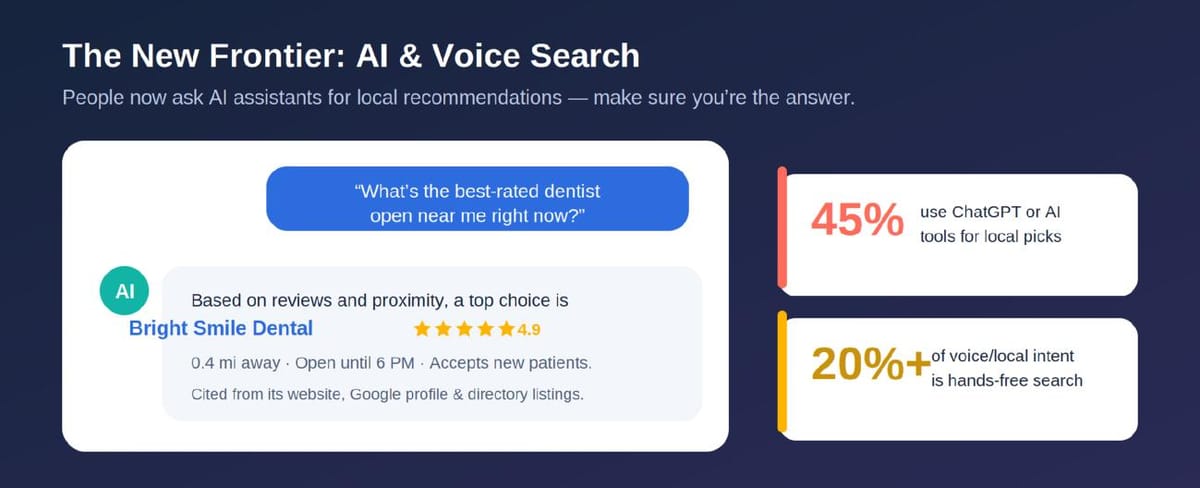
To get ahead: write in a natural, conversational tone that answers full questions; add clear FAQ sections (and FAQ schema); keep your reviews and listings consistent across third-party sites that AI engines read; and make sure your core facts — services, location, hours — are stated plainly on your pages. Your review reputation and structured information now flow into AI answers whether you manage them or not, so it pays to manage them deliberately.
Fix your broken links
Broken links frustrate visitors and quietly weaken your rankings. Google uses links to discover and assess pages; when a page 404s, those signals are lost. Run a quick crawl every few months, repair or redirect dead links, and you'll protect both your customer experience and your local search authority — a small task with an outsized payoff.
Ready to own your local market?
These 10 steps work — but they take consistent effort across reviews, listings, content, and your website. That's where we come in. We handle the heavy lifting so you can focus on running your business, while more local customers find you first.
Get in touch with us for your free local visibility check