
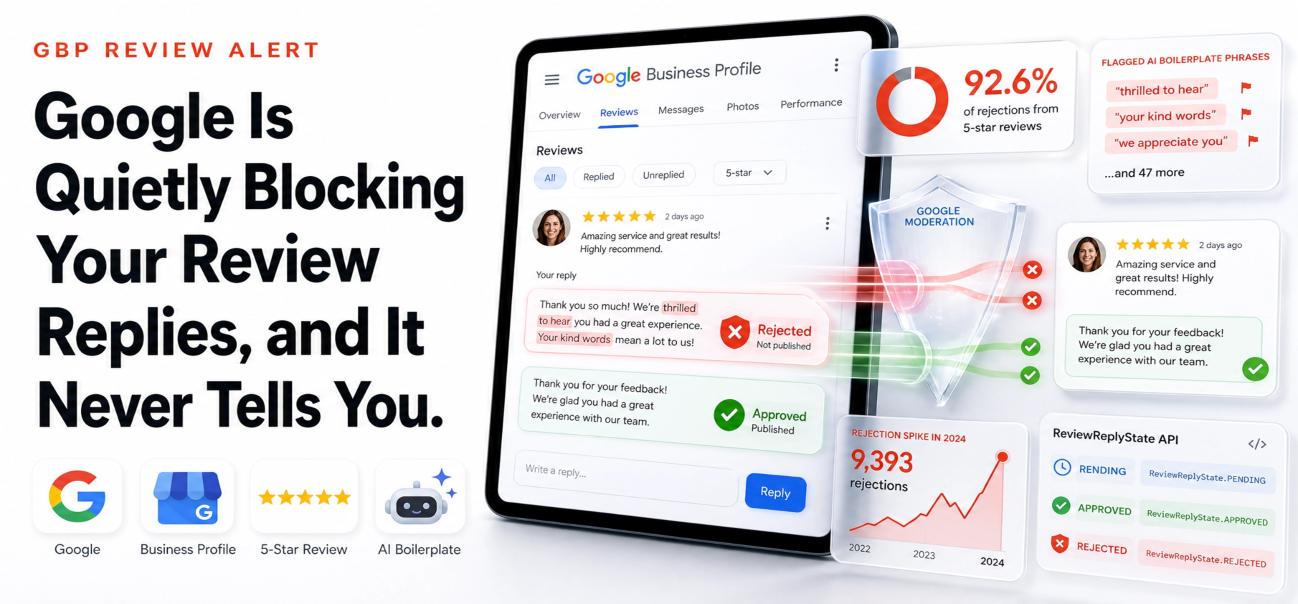
Google Is Quietly Blocking Your Review Replies, and It Never Tells You
A study of 12,752 rejected Google review replies reveals the language and publishing patterns most likely to trigger moderation.
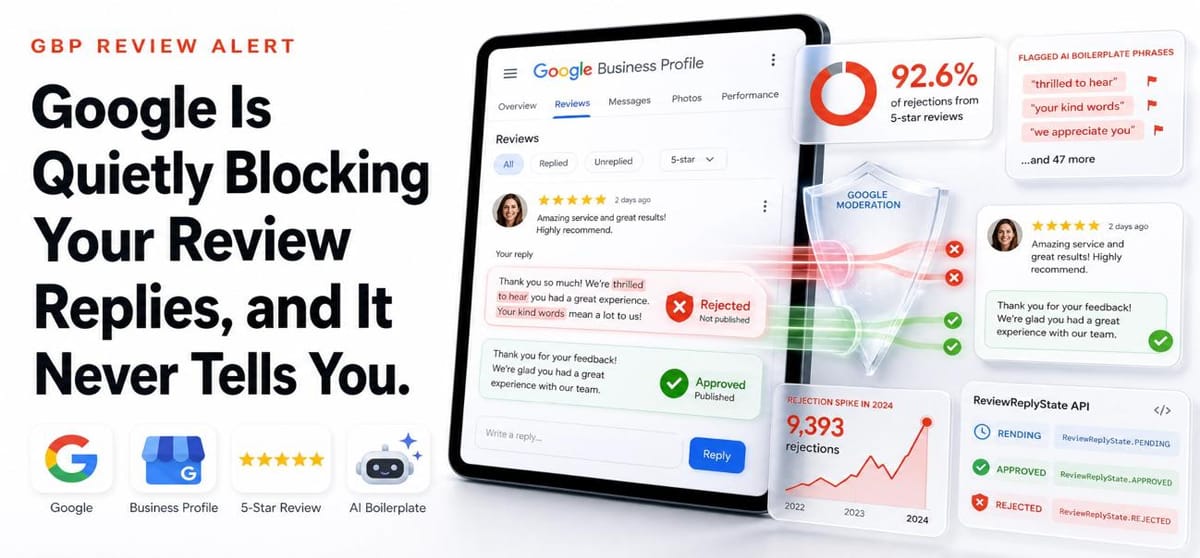
You hit reply on a customer review, the text looks fine, and you move on to the next one. What you may not realize is that a growing share of those replies never actually go public. Google does not send an error, an email, or a dashboard flag. The reply simply does not appear.
A new study of 12,752 rejected replies is the first look at this moderation filter at scale, and the patterns are specific enough to act on today.
What Changed
Since April, the Google Business Profile API has exposed a field called ReviewReplyState on every reply, with one of three values: pending, approved, or rejected. Before this, every reply pushed through the API went live automatically, with no moderation layer in between.
For anyone managing reviews at volume, this is the important part: if you reply through a tool that does not show ReviewReplyState, you are publishing blind.
The Study
A Google Business Profile management platform pulled 12,752 rejected replies and published the breakdown:
- 6% of rejected replies were responses to five-star reviews.
- Rejections spiked in 2024 — from 354 in 2022 and 398 in 2023 to 9,393 in 2024 alone.
- The average rejected reply went out about 50 days after the original review, a clear fingerprint of bulk, scheduled responding.
The Single Biggest Trigger: AI Boilerplate
67% of every rejected reply contained at least one detectable AI boilerplate phrase. The phrases most often found:
| Phrase | Appears in rejected replies |
|---|---|
| thrilled to hear | 48.7% |
| your kind words | 31.0% |
| thank you for your kind | 20.4% |
| look forward to serving you | 19.5% |
| welcoming you back | 14.8% |
| we strive to | 9.1% |
| feel free to | 6.6% |
| your satisfaction is our | 5.8% |
The Other Triggers
- Profanity the filter reads out of context — reviewer names, business names, and menu items can all trigger it.
- Exact duplicates and thin replies. One account sent "Thank you!" verbatim to more than 100 consecutive reviews, all rejected.
- Contact details in the reply body. Embedded email addresses and "call us" language get treated as off-platform solicitation.
- Hashtags. Every one of the 38 replies containing hashtags was rejected.
- Bulk velocity. 78.7% of rejected replies were posted more than 24 hours after the review.
How to Keep Your Replies Live
- Confirm your tool surfaces ReviewReplyState. We have already built this into our dashboard.
- Run a profanity pre-check on the full text including reviewer names and business name.
- Kill exact-duplicate templates. Every reply should vary, even slightly.
- Strip contact details out of templates.
- Spread replies across time and aim to reply within 24 hours.
Why This Matters for Agencies
Review replies are a trust signal that both customers and Google read, and a rejected reply means your side of the conversation never reaches the public. The fix is to stop sounding automated. Name something specific from the actual review, vary the language, and make sure you can see whether each reply actually posted.
Source study: Google Rejected Review Replies Analysis
Need a review-management process that protects customer trust? Talk to our team about building one that scales.