
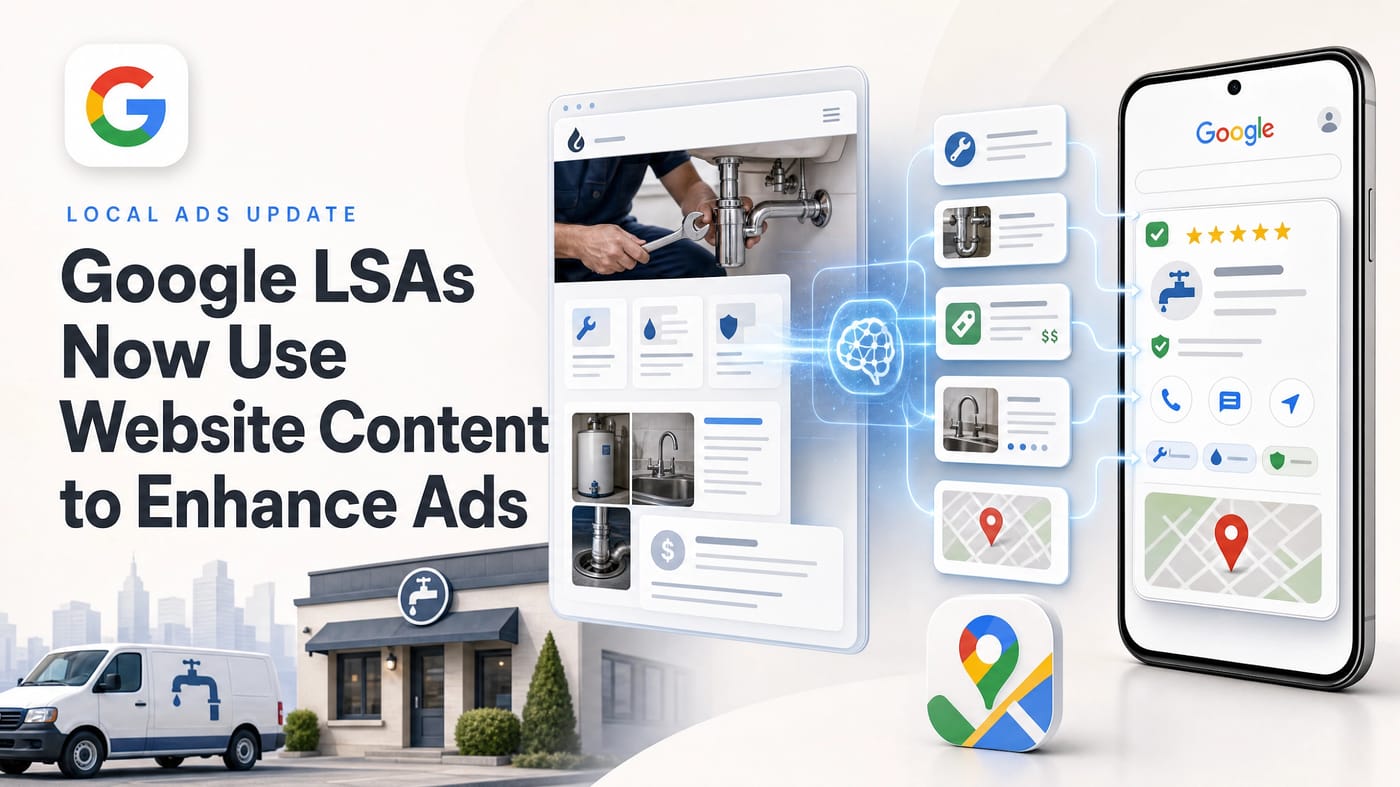
Google LSAs Now Use Website Content to Enhance Ads
Google is now using website content to enrich Local Service Ads, which makes the connected landing page part of the ad experience. Outdated content, old pricing, and unclear messaging can now directly affect your highest-value leads.
Google has recently introduced a significant update to how Local Service Ads (LSAs) operate. In the past, LSAs were primarily static, profile-driven placements — businesses would complete the dashboard, gather reviews, and that information largely determined what users saw. That model is now shifting. Google's AI is actively crawling the URL linked to your LSA and pulling content directly from your website to enhance what appears in the ad itself. This means the quality and accuracy of your website now has a direct effect on your most expensive lead source.
What Content Google Pulls Into LSAs
This new approach focuses on extracting three types of content from your landing page or homepage:
- Specific service details: If your website includes detailed offerings like "24/7 Emergency Pipe Burst Repair" but your LSA profile only lists "Plumbing," Google can now surface that level of detail directly in your ad — allowing better alignment with long-tail searches your dashboard may not explicitly include. This is why clear, structured web development and copywriting matter beyond just ranking.
- Pricing and offers: References such as "Free Estimates" or promotional discounts found anywhere on your page can be pulled into the ad interface — including offers that may no longer be actively promoted. Keeping your site current is no longer optional if you run paid search campaigns.
- Visual assets: High-quality images of your work from your website may be used to complement the visuals already included in your LSA profile. This is one more reason professional website design pays dividends beyond the site itself.
Benefits and Drawbacks to Consider
Benefits
- Ads can match more specific long-tail queries without manually selecting every service in the dashboard.
- Real website content makes ads feel more authentic and detailed compared to generic templates.
- Ads may appear more complete than those from competitors using unattended profiles — a meaningful edge for businesses with a well-maintained website and active paid search strategy.
Drawbacks
- Google's AI may highlight content or promotions you did not intend to feature in paid ads.
- A slow, outdated, or error-prone landing page can now directly impact your most expensive lead source. If your site is overdue for attention, managed hosting and support keeps it current and performant.
- There is potential for misinterpretation — such as confusing service areas with physical office locations.
Opt-Out Limitations
There is currently no direct option in the LSA dashboard to disable this feature. Google treats it as an automated enhancement tied to its organic crawling process. However, two indirect approaches can help maintain control:
- The URL lever: Updating the website link in your LSA profile to a simplified landing page allows you to control exactly what content Google can access and display. A focused conversion-optimized landing page built for this purpose gives you the most control over what Google reads and what users see when they arrive.
- Robots.txt blocking: While technically possible, restricting Googlebot access is not recommended, as it may negatively affect your organic search performance.
Adjusting Your Strategy
- Audit your landing page immediately: Outdated promotions, expired offers, and old pricing references — including those in footers — can now be pulled into ads, potentially leading to mismatched expectations and wasted ad spend. If your site needs a full review, our web development team can help.
- Structure your services clearly: Use H2 and H3 headers for key categories such as "Emergency Services" or "Same-Day Availability." Structured content helps Google interpret your offerings more accurately — and improves your SEO at the same time.
- Implement LocalBusiness schema markup: Schema provides clear, structured data about your services, locations, and contact details, reducing the chances of incorrect interpretation.
- Ensure consistency between ad and page: If a service or offer appears in your ad, it must be easy to locate on the landing page. If users cannot find what was promised, bounce rate increases and your conversion rate suffers.
Bottom Line
Your website is now a part of your LSA creative — whether intentionally optimized or not. This update brings clear advantages for businesses with strong, current websites, and real risks for those that don't. Treat your LSA-linked landing page as active ad copy and manage it accordingly. To get your paid search and website working together the right way, talk to the Ruby Shore team or start a project. More paid search and digital marketing guidance is available in the Ruby Shore Insights library.
Are your LSAs backed by a landing page that converts?
Ruby Shore builds and optimizes the full paid search picture — from landing page copy to LSA profiles — so your ad spend works harder.