
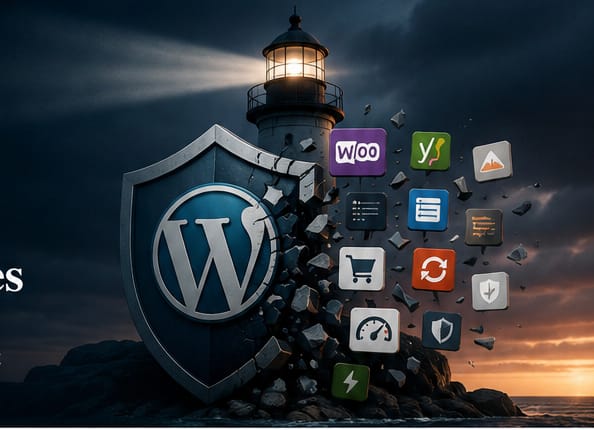
The Hidden Risk of Plugin-Dependent WordPress Websites
Plugin-heavy WordPress websites create security, maintenance, and business risk that most owners don't notice until something breaks. This is what growing businesses need to understand about plugin dependency and patch lag.
WordPress is flexible, widely supported, and backed by a large ecosystem of plugins and developers. That flexibility is one of the main reasons it became so popular. But that same flexibility can quietly create a risk most businesses don't notice until something breaks.
WordPress is not the problem by itself.
Over time, many business websites stop being a clean WordPress site and become a stack of plugins layered on top of each other. One plugin handles forms. Another handles SEO. Another handles redirects. Another handles caching. Another handles page layouts. Another handles popups. Another handles maps. Another handles tracking. Another handles security. Another handles backups. Another connects to a CRM.
At first, that can feel efficient. A business needs a feature, someone adds a plugin, and the site keeps moving.
The risk shows up later.
Every plugin adds another piece of third-party code that has to be trusted, updated, monitored, and maintained. Every plugin adds another vendor. Every plugin adds another possible compatibility issue. Every plugin adds another place where a vulnerability can appear.
That does not mean every plugin is dangerous. It means plugin dependency should be treated as a business risk, not just a technical detail.
The issue is not just vulnerabilities. It is patch lag.
Most businesses understand that software needs updates. What is easier to miss is the gap between a security fix being available and that fix actually being applied, tested, and confirmed on a live business website.
That gap is patch lag.
It is also where most of the real exposure lives.
A plugin developer may release a fix. A security company may publish an advisory. The vulnerability may be known. But if the business does not have someone actively responsible for the website, the site may continue running the vulnerable version for weeks, months, or longer.
That is especially common when no one is sure who owns the site. The business owner assumes the website company is watching it. The marketing team assumes the host is handling updates. The host may only be responsible for the server. The old agency may no longer be under contract. The internal team may be afraid to update anything because the last update broke a form, a layout, or an integration.
The patch exists, but the business is still exposed. That is the real problem, and it is exactly the kind of gap that Managed Hosting & Support is designed to close, with someone clearly responsible for updates, backups, monitoring, and testing.
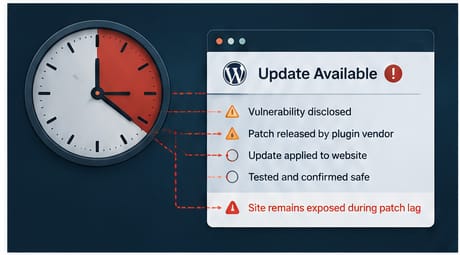
Patch lag is the gap between a fix being available and the website actually being updated, tested, and confirmed safe.
A plugin-heavy site creates more points of responsibility.
A small WordPress site with a handful of carefully selected plugins can often be managed responsibly. But many business websites do not stay small. More pages get added. More forms get created. More marketing tools get connected. More tracking scripts are added. More features are requested. Over time, the site becomes harder to understand and harder to maintain.
The risk is not only that one plugin could have a vulnerability. The risk is that no one has a clear picture of the whole system.
- Which plugins are active?
- Which plugins are actually being used?
- Which ones were installed years ago for a feature that no longer exists?
- Which ones are abandoned?
- Which ones are critical to lead generation?
- Which ones have access to customer data?
- Which ones could break the site if they are updated without testing?
Those questions matter because security is not just about clicking update. A responsible update process includes backups, testing, compatibility checks, monitoring, and a plan if something breaks. Without that process, businesses often delay updates out of fear, and that delay is exactly what attackers count on.
Business-critical features such as lead forms, integrations, and portals should be built to last, not handed off to another plugin. Web Development that reduces unnecessary plugin dependency makes ongoing maintenance more predictable and the site less fragile.
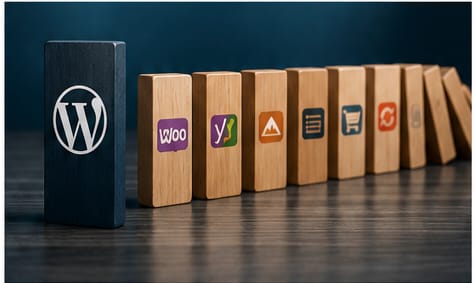
Every plugin becomes another dependency. The more a site depends on, the more important ownership and maintenance become.
The business impact is bigger than the website.
When people think about website security, they often think about a homepage being defaced or a site going offline. But the damage can go much further. A vulnerable website can affect lead generation, customer trust, internal workflows, and brand reputation. Attackers may inject spam pages, redirect visitors, create fake administrator accounts, steal form data, or use the site to distribute malware.
For a growing business, the website is rarely just a website. It is often the first place a prospect evaluates the company. A compromised site can quietly undermine the credibility that Website Design was built to establish, affecting user experience, messaging, performance, and the ability to generate qualified leads.
Beyond the site itself, a poorly maintained WordPress install can directly damage Online Marketing performance. Search engines penalize or deindex compromised sites, paid campaign landing pages lose quality scores, analytics data gets corrupted, and rankings can drop overnight when attackers inject spam content or redirect organic traffic.
The plugin supply chain matters.
When a business installs a plugin, it is trusting the people who build and maintain it, and trusting that the plugin will continue to be supported. Will it keep being maintained? Will ownership change? Will updates continue? Will the developer respond quickly when a vulnerability is discovered?
Most business owners never ask those questions. They only see the feature the plugin provides. But modern websites depend on software supply chains. A WordPress plugin is not just a feature. It is a dependency. If a site relies on dozens of plugins, the business is depending on dozens of outside teams to keep doing their jobs well. That is manageable when it is intentional. It becomes a problem when plugins are added casually and never revisited.
Better website strategy starts with ownership.
The answer is not always to abandon WordPress. There are situations where it can still make sense, when it is built carefully, maintained consistently, and supported by a team that understands the full environment. The real question is whether the business has a clear ownership model.
Someone needs to own the full website system. Not just the design. Not just hosting. Not just plugin updates. Not just SEO. The whole thing.
That includes:
- Knowing what the site depends on.
- Reducing unnecessary plugins.
- Keeping themes and plugins updated.
- Testing updates before they affect the live site.
- Maintaining secure backups.
- Monitoring for suspicious behavior.
- Understanding which forms, integrations, and tracking tools are business critical.
- Planning custom functionality instead of forcing every need through another plugin.
- Making sure the hosting environment, website code, CMS, and marketing stack work together.
Many businesses get stuck here not because the problem is complicated, but because no one is clearly responsible for it. They do not need one more plugin. They need a clearer ownership structure.
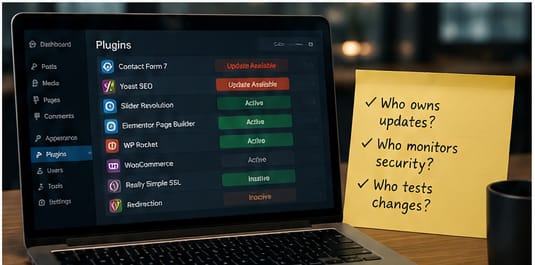
Security is easier to manage when someone clearly owns the website, the update process, and the long-term support plan.
When a business may have outgrown its website setup
There are a few signs it may be time to rethink the platform or support model: the site depends on a large number of plugins, updates are being delayed out of fear, lead forms or integrations are business critical, performance issues keep coming back, no one on the team knows what every plugin does, or multiple departments are depending on the website to function correctly.
It may also be worth rethinking the setup when the website needs capabilities that WordPress was never built to handle cleanly, such as complex workflows, customer portals, operational integrations, or data-driven tools. At that point, Custom Software Development is often a better answer than forcing WordPress to do everything through another plugin.
Sometimes the right answer is a more tightly managed WordPress environment. Sometimes it is custom development. Sometimes it is a rebuild with fewer dependencies and clearer ownership. That depends on the business and what it actually needs.
The main takeaway
WordPress is not automatically insecure. But a plugin-dependent WordPress site with no clear owner can become a serious liability.
The issue is not just whether vulnerabilities exist. They will always exist in software. The issue is whether the business has the people, process, and platform in place to respond quickly when they do. A website should not become a pile of unmanaged dependencies that no one fully understands.
For growing businesses, the better question is not "Can we add another plugin?" It is "Is this website still built, managed, and supported in a way we can actually trust?" Ruby Shore brings together website, software, and marketing services so those decisions reflect the full picture, not just one piece of it.
Need a clearer plan for your website?
Ruby Shore helps growing businesses build websites that are secure, maintainable, and built for the long run, with clear ownership and less plugin risk.