

Google Improves Search Console by Fixing a Key Reporting Issue
Google Search Console now lets users view performance data by day, week, or month, helping SEOs reduce daily reporting noise and focus on clearer trends.
Some updates change rankings. Others quietly change your day-to-day sanity. This month's biggest Search Console improvement falls squarely into the second category. Google has rolled out a long-requested enhancement to Search Console Performance reports: time-based granularity controls that let you view data by day, week, or month — right inside the interface.
No exports. No spreadsheet gymnastics. No pretending those weekend dips mean anything.
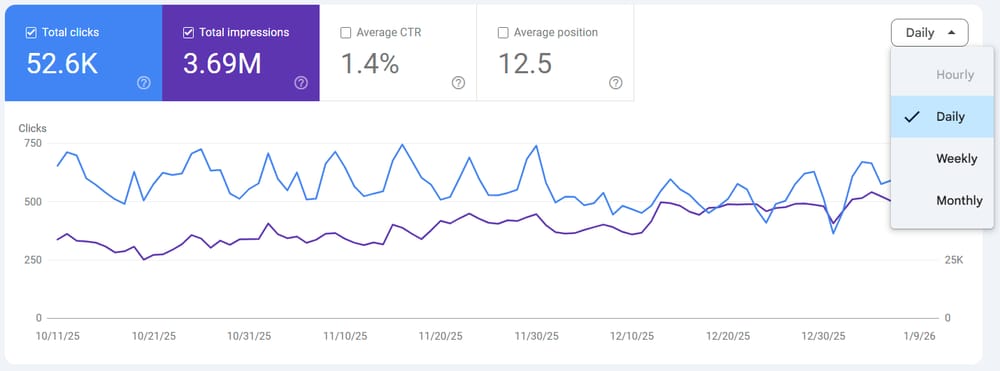
The new granularity selector in Search Console Performance reports — toggle between daily, weekly, and monthly views without leaving the interface or exporting data.
What's New (and Where You'll Find It)
Inside the performance report, Google has added a granularity selector located next to the date range filter. With one click, you can now toggle between:
- Daily: The familiar view, still useful for debugging sudden drops
- Weekly: Data grouped into Sunday–Saturday intervals
- Monthly: Clean, calendar-month aggregation
The underlying data hasn't changed. The way it's visualized has — and that makes all the difference. This complements the other data source now available inside Search Console: as covered in our article on Search Console expanding to social profiles, Google is increasingly treating Search Console as a multi-surface performance tool, not just a web-ranking dashboard.
Why Daily Charts Were Lying to You
Daily-only charts have always been a problem — especially for healthy sites. Most websites follow predictable behavioral patterns:
- B2B sites dip on weekends
- E-commerce spikes around promotions
- Holidays distort impressions and clicks
Daily graphs exaggerate these patterns, creating artificial volatility that looks like instability but isn't. The result? Panic, over-analysis, and unnecessary explanations to stakeholders. By letting you zoom out, Google is finally acknowledging what SEOs already knew: trend matters more than noise.
This is especially relevant for SEO reporting to clients who aren't deeply familiar with search data. A weekly or monthly view tells the real story of whether a strategy is working, rather than triggering concern every time a weekend rolls around.
What This Changes for Real SEO Work
This update quietly unlocks several practical improvements:
- Clearer trendlines: Growth, stagnation, and decline are now visible without squinting past daily fluctuations.
- More accurate comparisons: Month-over-month analysis finally compares like with like — no more mismatched weekday counts.
- Better executive reporting: Charts are presentation-ready straight from GSC. No exports required.
- More meaningful tables: Queries and pages now align with the selected granularity, making seasonality and demand shifts easier to spot.
In short: fewer false alarms, better decisions. This update pairs well with the 24-hour export update for teams that need both granular debugging and long-term trend analysis.
For businesses running paid search alongside organic, having cleaner organic trend data is also useful for isolating the true incremental impact of paid campaigns versus organic momentum.
Availability and Coverage
- Rollout: Global, across all verified properties
- Reports supported: Search Results, Discover, and Google News
- Setup: None — if you don't see it yet, it's still rolling out
The Takeaway
This isn't a headline-grabbing algorithm update — but it removes one of the most persistent sources of friction in SEO reporting. Search Console is finally optimized for how professionals actually analyze performance: zoomed out, trend-focused, and grounded in reality.
For any business that relies on data to make digital marketing decisions, this is a meaningful improvement. Understanding the difference between daily noise and real trend movement is one of the core skills that separates strategic SEO from reactive, panic-driven changes. Combined with the insights from auditing 500+ websites, the lesson is the same: focus on what actually matters, not what the daily chart is screaming at you today.
Want SEO reporting that actually tells you what's working?
Ruby Shore builds clear, trend-focused SEO reporting that helps clients make confident decisions — without the noise, panic, or spreadsheet gymnastics.
Sources and further reading
- Google Search Central: Weekly and Monthly Views in Search Console